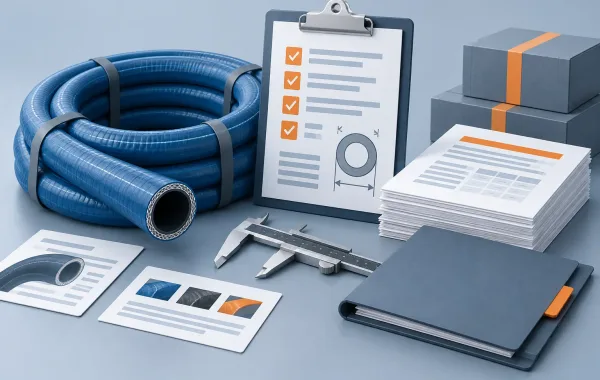
When buying PVC layflat hose in volume, a lower price per metre can look like an immediate saving. But it is only a saving if the quoted product meets the same requirement and the total purchasing cost remains lower.
A fair comparison starts with a fixed specification, then checks quantities, packaging and the delivery basis. This approach is useful for distributors evaluating a new supplier or reviewing a replenishment order.
1. Confirm that both offers describe the same requirement
Record the proposed product code, nominal size, actual inner diameter, construction, coil length and current specification revision. Ask each supplier to confirm suitability for the stated medium, operating conditions and intended service.
Working pressure should be read with the conditions under which the supplier specifies it. A burst-pressure figure does not replace a working-pressure rating. If temperature, pressure variation or fittings affect the selection, ask for written confirmation against the intended application.
Colour and duty labels are useful descriptions, but they should not be the basis of technical acceptance. Two blue layflat hoses are not necessarily equivalent products.
Review SUNHOSE's current layflat product information here, then request confirmation for your selected model:
Review PVC layflat hose specifications
2. Match the order quantity and sale unit
Check whether the quotation is per metre, per foot, per roll or per package. Record the length per roll and total purchased length separately. If your customers require particular continuous lengths, confirm that the proposed supply format supports those orders.
For example, a distributor that resells full coils may value consistent coil lengths and clear labels. A distributor supplying specified cut pieces may also need to consider whether its stock format produces useful remaining lengths. The same total metres can serve those businesses differently.
3. Compare the cost to the same destination
Build a worksheet with separate rows for goods, packaging, origin charges, freight, insurance where applicable, destination handling and inland transport. Add applicable duties and non-recoverable taxes using information confirmed for your own shipment. Keep recoverable taxes separate from permanent cost, while including them in cash-flow planning where relevant.
The purpose is not to make every quote include every charge. It is to make the boundaries visible and avoid either omitting or counting a cost twice. Ask a freight provider or customs adviser to confirm shipment-specific charges and classification when needed.
4. Use a transparent calculation
The following figures are fictional teaching examples, not actual quotations. Both offers are assumed to meet the same approved specification and provide 10,000 saleable metres. All relevant non-recoverable costs are assumed to be included in the stated additional costs.
Offer A:
Goods: 10,000 m × USD 0.80/m = USD 8,000.
Additional costs to the agreed destination: USD 2,200.
Total: USD 10,200, or USD 1.02 per saleable metre.
Offer B:
Goods: 10,000 m × USD 0.84/m = USD 8,400.
Additional costs to the same destination: USD 1,500.
Total: USD 9,900, or USD 0.99 per saleable metre.
In this example, Offer B has the higher goods price but the lower total cost. That conclusion depends on equivalent product acceptance, quantities and cost coverage. It does not suggest that a particular delivery term is always cheaper.
5. Resolve uncertainty before placing the order
Ask what the quoted schedule depends on: specification confirmation, artwork approval, deposit receipt or material availability. Distinguish the proposed production completion date from the expected arrival date.
Also confirm how discrepancies will be recorded and reviewed. Keep the quotation, agreed specification, approved sample reference and purchase order connected by item number. That record helps when receiving goods and placing repeat orders.
A useful supplier comparison ends with three answers: Does the product meet the requirement? What is the total cost on the same basis? Which assumptions remain unresolved?
For a SUNHOSE layflat hose quotation, send your required size, service conditions, coil length, quantity, packaging and destination. Ask the team to identify the proposed model and commercial basis:
Send your requirements to SUNHOSE