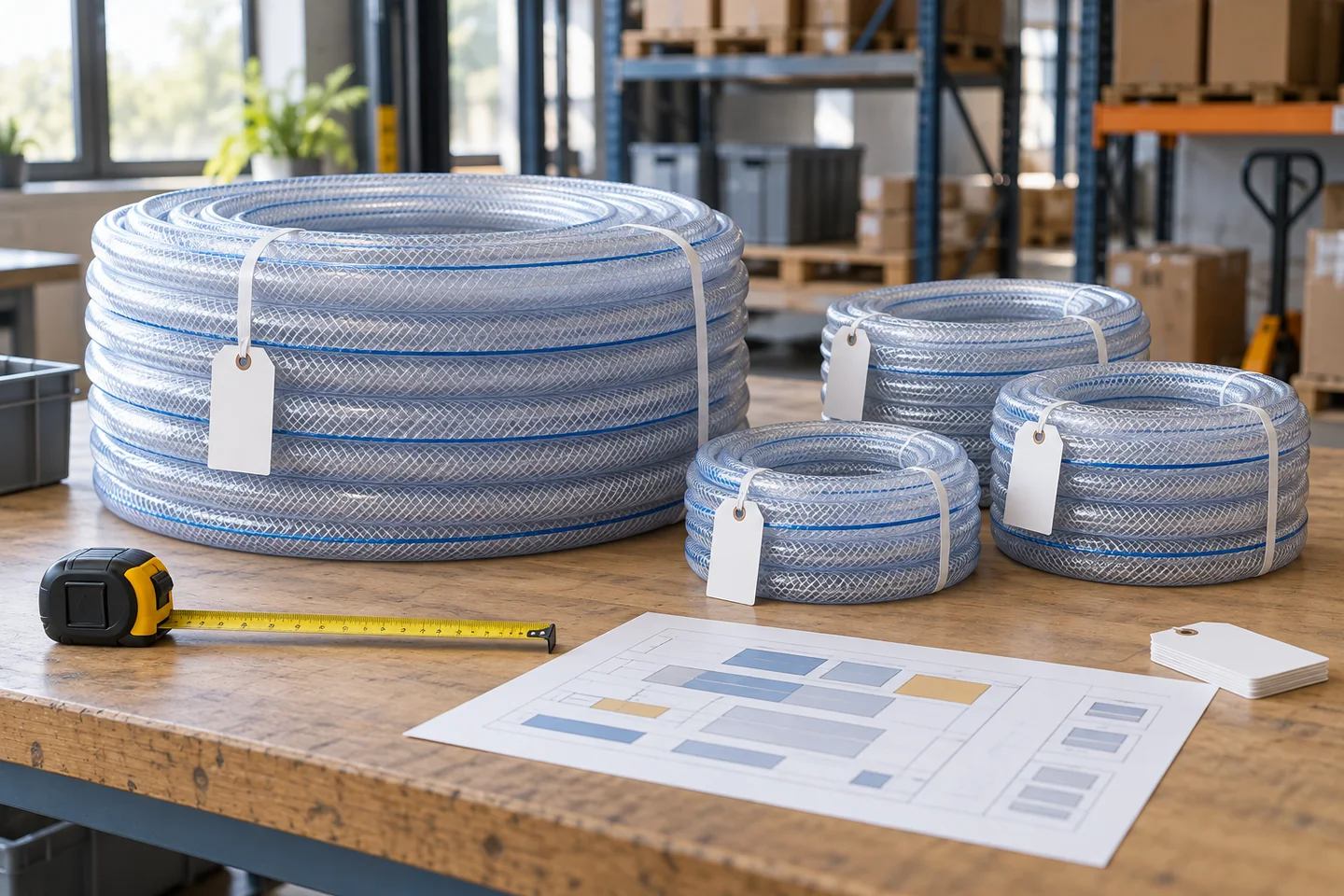
A warehouse may hold enough meters of hose to cover an order and still be unable to supply the required continuous lengths. Two separate 12 m remnants do not satisfy a request for one uninterrupted 20 m piece. For distributors selling hose by length, stock availability is therefore both a quantity question and a piece-length question.
Coil allocation is the planning step between accepting a customer order and releasing a cutting job. It assigns each required piece to a particular stock coil and preserves a record of the remainder. This article addresses that allocation decision, not cutting-machine setup, blade selection or assembly manufacture.
Define the unit you are promising to deliver
Record the requested continuous length, quantity and approved length acceptance criteria before planning. Also establish whether the order is for bare hose or a finished assembly. An assembly length may use a defined reference between fittings, so it cannot automatically be treated as the required bare-hose cut length.
Group demand only when the product identity matches. Construction, size, grade and any customer-specific requirements must agree. A piece of clear reinforced PVC hose cannot replace a different construction simply because it would make the cutting plan fit. Use the identifiers in your product record to avoid mixing similar-looking stock.
Use verified usable length, not the roll label alone
For each available coil, start with its verified remaining length and identify material that cannot be released to the order. Separately allow for the losses associated with the approved cutting and measurement process. These may include end trimming, inspection samples or other process-specific allowances. Do not assume that every method loses the same amount.
Planning balance = verified coil length − excluded material − planned process allowance − allocated customer lengths.
Keep those deductions in separate columns so the balance is auditable. The remaining number is a planning estimate until the actual work is completed and the remainder is checked. If the supplier's length tolerance or your measurement uncertainty could eliminate the planned margin, change the allocation before promising the order.
A worked example: three lengths from two coils
The following numbers are fictional and demonstrate allocation only. Assume two coils each have 100.0 m of verified available material. The approved job plan reserves 1.0 m per coil for all process allowances. That leaves 99.0 m per coil to allocate. This 1.0 m reserve is not a recommended allowance for any particular hose or cutting process.
The customer needs three 18 m pieces, four 12 m pieces and five 8 m pieces of the same approved hose. Total saleable demand is:
(3 × 18) + (4 × 12) + (5 × 8) = 142 m.
| Stock coil | Proposed allocation | Customer length | Planned remainder after reserve |
|---|---|---|---|
| Coil A | 3 × 18 m + 3 × 12 m + 1 × 8 m | 98 m | 1 m |
| Coil B | 1 × 12 m + 4 × 8 m | 44 m | 55 m |
| Total | All 12 requested pieces | 142 m | 56 m |
The accounting balances: 142 m for customers, 2 m reserved for the process and 56 m of planned remainder equals the original 200 m. Allocating 98 m to Coil A leaves only 1 m beyond the stated reserve, so that pattern is suitable only if the verified length and approved allowances support it. A less concentrated allocation may be preferable when uncertainty is higher.
A useful remainder can matter more than a tidy percentage
In this example, concentrating compatible pieces creates one 55 m remainder instead of several smaller balances. That may help serve a later order requiring a long continuous piece. It does not prove that this is the cheapest or mathematically optimal plan. Customer priorities, permitted batch mixing, handling time and future demand can change the preferred allocation.
The current order uses 142 ÷ 200 = 71% of the opened stock length as customer pieces. Calling the other 29% “waste” would be misleading: it contains both the process reserve and potentially reusable stock. Report saleable output, actual process loss, reusable remainder and unusable scrap separately.
A remainder is commercially useful only if its identity, condition and verified length support another accepted order. A large quantity of anonymous short pieces should not be treated as interchangeable stock in the purchasing system.
Release a cut list that the next person can follow
- Source: coil identifier, product SKU and any required batch restriction.
- Demand: customer order line, piece count and required finished length.
- Method reference: approved measurement and cutting instructions, including allowances.
- Sequence: which pieces are assigned to the coil, with a stop point if the balance differs from the plan.
- Closeout: actual pieces released, actual losses and checked remaining length.
Do not join short pieces to satisfy an order that requires continuous hose. Where a customer needs an assembled solution, its design and approval are separate from this material-allocation worksheet.
Use the results to improve the next purchase
Review which remnant lengths repeatedly sell and which accumulate. If customers usually request a narrow set of lengths, discuss available supply formats with the manufacturer before the next bulk purchase. A different coil length might simplify allocation, but evaluate it against confirmed availability, handling and order requirements rather than assuming longer is always better.
Keep long-term replenishment separate from today's cut list. The seasonal planning guide explains how to translate usable stock and expected demand into a time-based purchasing view.
Frequently asked questions
Should the longest piece always be allocated first?
It is a useful starting heuristic because long continuous requirements have fewer stock options. It is not a guarantee of the best plan. Compare feasible patterns and preserve stock needed for higher-priority orders.
Can all remnants be added to available meters?
They can be totaled for reporting, but fulfillment must also check individual piece lengths. Keep a separate view of stock that can actually satisfy each continuous-length requirement.
What information helps SUNHOSE discuss supply lengths?
Share the selected hose family, size, expected piece-length mix and purchase volume. Ask SUNHOSE which supply configurations can be confirmed for that product.