A distributor can receive a perfectly usable hose specification and still publish a misleading product listing. The error often happens when a spreadsheet becomes a website: a pressure value loses its temperature note, a nominal size becomes an exact dimension, or a photograph is attached to every variant in a family.
A useful hose catalog record preserves the meaning of the supplier's data while making it easier to search. The practical objective is simple: a buyer, salesperson and warehouse operator should identify the same product from the same record. This guide focuses on catalog publishing after a product has been selected; it does not establish manufacturing tolerances or approve a hose for a particular service.
Start with one record for each orderable variant
A product family page explains a construction. An orderable record identifies what the customer actually receives. Keep those levels separate. A range of clear reinforced PVC hose can share an introductory description, but different diameters and supplied lengths should have their own variant records.
Use a stable internal SKU as the record key. Store the supplier's product code in another field rather than replacing your identifier whenever a supplier changes its naming convention. Keep color, supplied length and packaging configuration explicit when they distinguish orderable items. A short descriptive SKU is helpful, but it should not be the only place where specifications are stored.
Build a field map before importing a spreadsheet
The following structure is a starting point for a catalog team. An empty technical field means the information is unconfirmed; it should not silently become zero or inherit a value from the nearest row.
| Field group | What to retain | Publishing check |
|---|---|---|
| Identity | Internal SKU, supplier code, product family and revision | Every public variant maps to one approved record |
| Dimensions | Nominal designation and documented dimensions in separate fields | A nominal label is not presented as a measured result |
| Service ratings | Rating type, value, unit and associated conditions | Working, proof and burst values cannot populate the same field |
| Commercial unit | Price unit, sale unit, supplied length and package quantity | Per-meter and per-roll offers are distinguishable |
| Evidence | Source document, issue date and reviewer | A published claim can be traced to its source |
| Media | Image identity, applicable variants and descriptive alt text | An illustrative image is not used as proof of a specification |
Normalize the display without changing the specification
Retain the supplier's original value and unit alongside any converted display value. Apply one rounding rule across the catalog and keep enough precision internally to avoid repeated conversion drift. A conversion changes how a number is expressed; it does not improve the accuracy of the source measurement or change the product's designation.
For example, a catalog search filter may use millimeters while customers search using inch-based names. Those can coexist as separate fields. Do not automatically treat every nominal inch designation as an exact bore measurement. Likewise, do not calculate an allowable working pressure from a burst figure unless the supplier has explicitly provided the applicable rating and its conditions.
Use controlled terms for missing information. “Not supplied,” “awaiting confirmation” and “not applicable” mean different things. Keep that distinction internally, and withhold unsupported performance claims from the public listing.
Check commercial units with a simple order example
Consider an illustrative record for a hose sold in complete 50 m rolls. The quote is expressed per meter, but the order form accepts rolls. A customer selecting three rolls should see 150 m as the supplied quantity, while the warehouse should receive a pick instruction for three rolls. The displayed price must make its basis clear.
This is a data-mapping example, not a SUNHOSE packing commitment. Use the confirmed supplied length for the actual product. If you also offer cut lengths, make the sale mode explicit so a customer cannot mistake three meters for three rolls. Your cut-length allocation record should reference the same SKU, not a manually typed product name.
Prevent a family-level claim from leaking into every variant
A spreadsheet fill-down operation can spread a value farther than intended. Before bulk publication, identify which fields genuinely apply to the entire family and which depend on size, construction, supplied format or documented approval scope.
- Keep rating conditions beside the rating, including any limitations supplied with it.
- Map certificates and declarations only to the products and uses their documents actually cover.
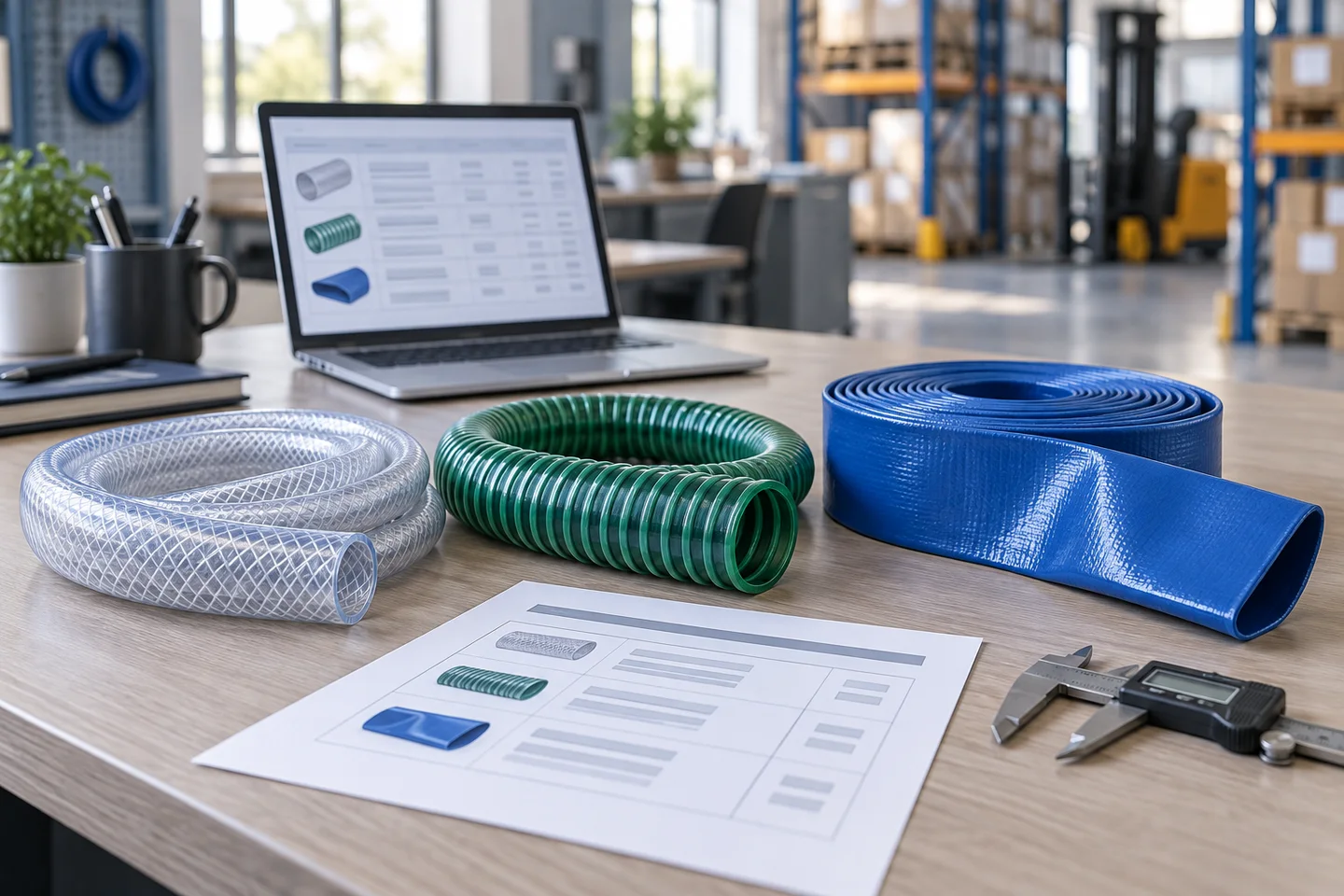
- Use an image of the relevant construction; color similarity alone does not establish equivalence.
- Keep replacement suggestions separate from technical approval. A similar diameter is not enough to authorize substitution.
The same approach is useful when organizing hydraulic hose and industrial rubber hose. The field names may be shared, but technical values must remain specific to the item.
Run a small publication test before a full import
- Select one simple variant and one record with conditions or multiple sale units.
- Compare the draft listing with the source document, including notes rather than just numbers.
- Place a test quantity in the order workflow and inspect the resulting pick description.
- Check mobile tables, search filters, image captions and downloaded documents.
- Record the reviewer and release date, then apply the same mapping to the remaining records.
Keep a reversible export of the previous catalog data. If a mapping error is discovered, pause the affected listings while correcting the record; do not solve it by adding an informal note that conflicts with the main specification table.
Questions catalog teams ask
Can one photograph represent several sizes?
It can illustrate a family when the construction is representative and the listing makes that role clear. It should not imply that every size has identical dimensions, fittings or performance.
Should missing ratings be copied from a similar hose?
No. Ask for the applicable source information and keep the field unconfirmed until it is available. A complete-looking table is less useful than an accurate one.
What should we send SUNHOSE for a catalog review?
Send the product codes, your proposed field template, sale-unit rules and the specific missing information. The product catalog is a useful starting point; contact SUNHOSE to confirm the data for the items you intend to list.